- Cyber incidents remain the greatest business risk for companies worldwide – at the same time, AI-powered attacks are intensifying the threat landscape and raising the bar for modern cybersecurity.
- Digital sovereignty is emerging as a critical success factor for the resilience, security, and competitiveness of companies and organizations in Europe.
- New regulations such as NIS2, DORA, and the AI Act are not merely compliance requirements; they offer companies the opportunity to modernize their security strategies and strengthen their digital resilience in the long term.
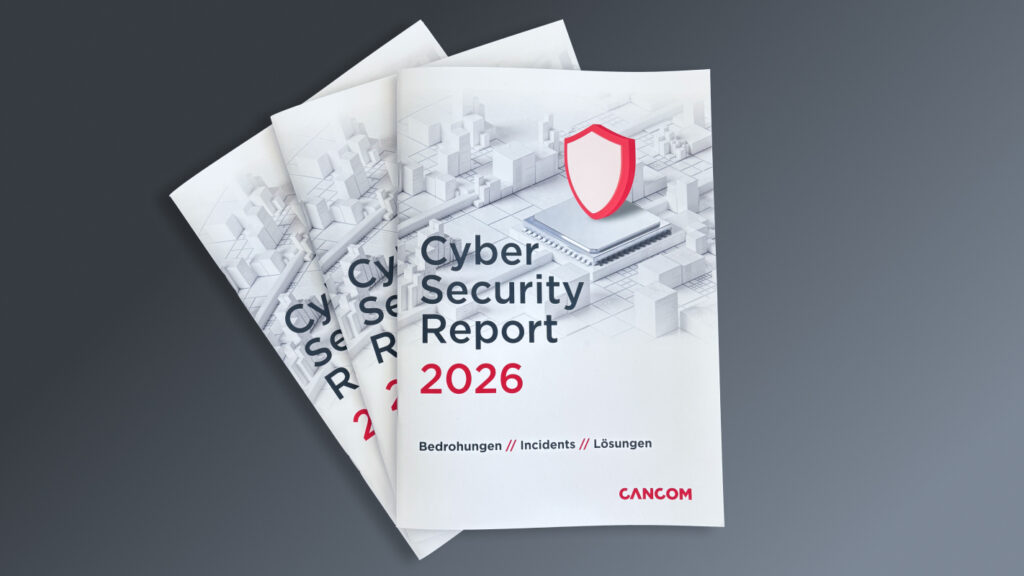
Cyberattacks remain the greatest business risk for companies worldwide. At the same time, artificial intelligence (AI), geopolitical tensions, and new regulatory requirements are fundamentally changing the security landscape. The new CANCOM Cyber Security Report 2026 analyzes these developments. For the report, CANCOM’s cybersecurity experts analyzed current threat trends, regulatory developments, and technological innovations, combining them with experience gained from security projects, incident response operations, and the operation of the Cyber Defense Center.
The analysis of threat trends and practical experience shows that AI is emerging as a key driver of the current threat landscape. Cybercriminals are already using AI to automate phishing campaigns, forge identities, or specifically avoid security mechanisms. Among other things, the CANCOM Cyber Security Report describes scenarios in which deepfake technologies are used to create fake job applicant profiles in order to infiltrate companies undetected.
At the same time, AI opens up new possibilities for cyber defense. Modern security solutions help companies detect suspicious activity more quickly, automatically analyze security incidents, and contain attacks at an early stage.
“Artificial intelligence is radically shifting the balance of power in cybersecurity: It makes attacks faster, more precise, and more scalable,” says Alexander Ernst, Director of the Competence Center – Network & Security at CANCOM. “But at the same time, it is one of the most powerful tools for defense. The key factor is who uses AI more effectively: attackers or defenders.”
Digital sovereignty is gaining in importance
One focus of the report is on Europe’s digital sovereignty. Given the heavy reliance on non-European technology providers, the ability to operate digital infrastructures in a controlled and resilient manner is becoming increasingly important for companies and public institutions.
The report clearly shows that digital sovereignty extends far beyond the issue of individual technologies. Transparency, control, resilient infrastructures, and the ability to make strategic decisions independently are crucial.
Regulation as a Driver of Innovation
With regulations such as NIS2, DORA, the Cyber Resilience Act, and the AI Act, regulatory pressure on companies continues to rise. However, CANCOM views this not merely as a compliance requirement, but as an opportunity for sustainable modernization and greater resilience.
The report highlights how companies can leverage regulatory requirements to professionalize security processes, systematically manage risks, and future-proof their digital transformation.
A Holistic Approach to Greater Digital Resilience
As a leading digital business provider and AI enabler, CANCOM pursues a holistic cybersecurity approach. This ranges from security consulting and compliance advisory services to managed security services, incident response, red teaming, and the operation of the CANCOM Cyber Defense Center.
More than 250 security specialists, over 60 analysts at the Cyber Defense Center, and more than two million critical alerts processed annually form the foundation for supporting companies, organizations, and the public sector in defending against modern cyber threats.
The complete CANCOM Cyber Security Report 2026 is now available for download.
(Available only in German)